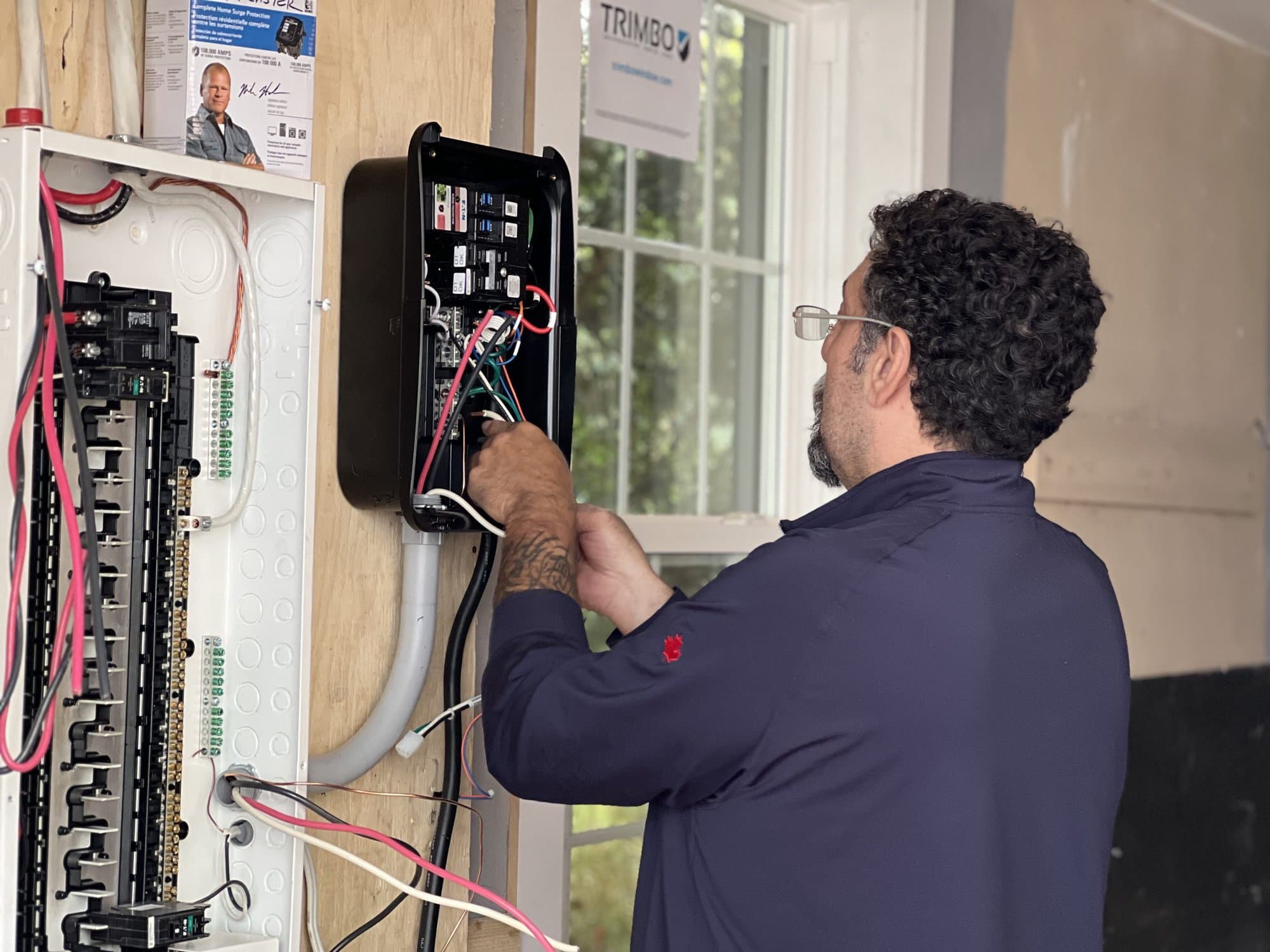
Residential EV Charger Installation
Get a licensed electrician to install a home EV charger that charges faster, smarter, and safely. Free quotes. No hassle.
Get a Free Quote →Act before June 30, 2026 — the federal Alternative Fuel Vehicle Refueling Property Credit (up to $1,000 for qualifying homeowners) expires in 3 days. Consult your tax advisor for eligibility. Our installers can complete your job in time. Get a free quote →
Why Upgrade to a Level 2 Home EV Charger?
A standard 120V outlet (Level 1) charges your electric vehicle slowly — adding only 4–5 miles of range per hour. A Level 2 home EV charger (240V) charges 5–6× faster, adding 20–30 miles per hour so your car is ready to go every morning. A dedicated circuit also protects your home's wiring from overload.
Our licensed electricians handle every step of your home EV charger installation: site assessment, permit filing, 240V circuit install, charger mounting, and the final inspection sign-off.
Popular Level 2 Home EV Chargers
This section contains affiliate links. We may earn a commission at no extra cost to you.
Our network electricians install all major Level 2 home EV charger brands, including:
- ChargePoint Home Flex — 16–50A adjustable, Wi-Fi, smart scheduling
- Wallbox Pulsar Plus — compact 40A charger, Wi-Fi + Bluetooth
- JuiceBox 40 / 48 — Wi-Fi-connected, utility rebate-friendly
- Grizzl-E Classic — rugged 40A hardwired charger, no-frills reliability
- Emporia EV Charger — affordable 48A smart charger with energy monitoring
- Tesla Wall Connector — best-in-class for Tesla vehicles (see Tesla page)
- Ford Charge Station Pro — required for F-150 Lightning V2H; needs a dedicated 100A circuit (see F-150 Lightning charger guide)
What's Included in Your Home EV Charger Installation
- Site assessment and electrical panel evaluation
- Permit application (most jurisdictions)
- 240V dedicated circuit installation
- Charger mounting and wiring
- Final test and homeowner walk-through
Home EV Charger Installation Cost
A standard Level 2 home EV charger installation typically costs $1,200–$3,000, depending on your electrical panel capacity, the length of the wiring run, and local labor rates. Simple installs near the panel can come in under $1,200; panel upgrades or long conduit runs can reach $3,000–$5,000. Outdoor or detached-garage installs add $200–$600 in materials and trenching.
The federal 30C tax credit covers 30% of equipment and installation costs — up to $1,000 for qualifying homeowners. Many electric utilities also offer rebates of $200–$500 on qualifying Level 2 chargers. Your electrician can point you to programs available in your area.
See our full EV charger installation cost guide →
Permits, Inspection, and What to Expect
Most jurisdictions require a permit for a Level 2 EV charger installation. Our network electricians pull the permit, install the 240V circuit and charger, and schedule the final electrical inspection — you do not need to coordinate anything with the city. Most installs complete in 2–4 hours on the day of work.
Do You Need a Panel Upgrade?
A Level 2 charger needs a dedicated 40–50A 240V circuit. Whether your panel can support that depends on its age and available capacity. Most 200-amp panels installed after 2000 have room. Older 100-amp panels and fully loaded 200-amp panels usually don't.
No upgrade needed
200A panel with open slots
$1,200–$2,500 installed
Subpanel add-on
200A panel that's full
+$800–$1,500
Service upgrade
100A or aging panel
+$1,500–$4,000
Your electrician will assess your panel at no charge during the site visit.Full panel upgrade guide →
Frequently Asked Questions
What is the difference between Level 1 and Level 2 charging?
Which Level 2 home EV charger should I pick?
Do I need to upgrade my electrical panel for a Level 2 EV charger?
How much does a panel upgrade add to EV charger installation?
Do I need a permit to install a home EV charger?
How long does a home EV charger installation take?
How much does home EV charger installation cost?
Can I install an EV charger outside or in a detached garage?
Get a Free Home Charger Quote
Licensed electricians · Fast response · No obligation
Request My Free Quote →30C tax credit — check eligibility with your tax advisor.